
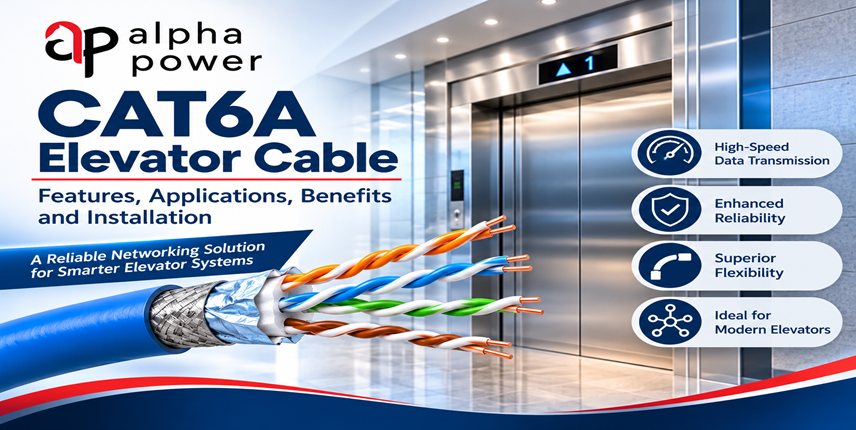
CAT6A Elevator Cable: Features, Applications, Benefits and Installation
Elevators in the UAE are no longer limited to just passenger transport. They are now equipped with features like IP-based CCTV cameras, emergency communication equipment, passenger information displays, and network-connected devices – all of which require dependable data transmission to operate. However, conventional data transmission cables, which may work fine in a static environment, cannot withstand the constant bending caused during the elevator movement. Modern elevators need a solution that can withstand the continuous travelling motion while maintaining high performance and data connectivity. This brings us to CAT6A elevator cables.
In this blog, we will discuss about what a CAT6A elevator cable is, its key features, applications, benefits, and compare it with other Ethernet cables and take a look at its installation requirements. Read till the end to understand what factors you should prioritise as a contractor when choosing a CAT6A cable manufacturer.
What Is a CAT6A Elevator Cable?
CAT6A, or Category 6A, is an Ethernet cabling standard designed to support 10 Gigabit Ethernet (10GbE) over a compliant channel of up to 100 metres. Operating at a bandwidth of 500 MHz, it offers higher data transmission capacity than conventional CAT6 elevator cables.
A CAT6A elevator cable adapts to the mechanical demands of an elevator installation and provides a reliable network connection between equipment inside the moving elevator car and the building’s fixed network infrastructure.
An important point to note here, a conventional CAT6A cable is designed for fixed installations and cannot automatically be used as an elevator travelling cable. It may meet the required electrical specifications but lack the flexibility needed for repeated movement.
A purpose-designed elevator travelling CAT6A cable addresses both requirements. Its construction supports the intended Ethernet performance while accommodating the bending and mechanical stresses associated with elevator operation.
Thus, CAT6A performance certification alone does not establish suitability for elevator use. You need mechanical validation for the intended travelling application.
Key Features of CAT6A Elevator Cable
The performance of a CAT6A elevator travelling cable depends on several electrical and mechanical characteristics, such as:
High Speed Data Transmission
One of the key features of CAT6A technology is its ability to support 10 Gigabit Ethernet at frequencies of up to 500 MHz. This allows it to handle considerably more data than conventional CAT6 and CAT5e cables.
This higher bandwidth is particularly useful in modern elevator installations, where IP CCTV cameras, network-connected displays and other devices need a reliable connection to transmit large amounts of data.
That said, simply choosing a CAT6A cable does not guarantee the expected network performance. Much depends on the installation as a whole, including the connectors used, the quality of termination and the conditions in which the cable is installed.
Twisted-Pair Conductor Arrangement
Elevator CAT6A cables are made up of four pairs of twisted copper conductors. This particular twisting feature helps to reduce electromagnetic interference and crosstalk between the pairs so data signals can travel with less disruption.
Their twisting needs to be consistent for higher transmission frequencies. Even small changes in the spacing or arrangement of the conductors can affect the cable’s electrical performance and signal quality.
CAT6A manufacturers maintain this consistency in CAT6A cables, especially for elevator applications. They also assess different conductor arrangements through repeated bending and movement tests to check whether they can maintain reliable data transmission over time.
Flexible Conductor Construction
Unlike standard fixed-installation cables, CAT6A elevator cables need to cope with constant movement as the lift travels up and down the building.
To handle this, manufacturers use stranded copper conductors rather than solid copper wires in CAT6A cables. The stranded construction gives the cable the flexibility needed for repeated bending during normal lift operation. They distribute mechanical stress when they are repeatedly bent, which decreases the chance of conductor fatigue.
Shielding Options
Elevator environments contain several electrical components, including motors, drives, control panels and power cables. These can produce electromagnetic interference (EMI) that can impact sensitive data transmissions.
CAT6A elevator cables include foil shielding, braided shielding or other appropriate shielding mechanisms depending on the application. They shield the cable against external interference and help to maintain signal integrity.
Mechanical Flexibility and Fatigue Resistance
During operation, elevators constantly move up and down the shaft. Over time, this movement can place considerable stress on the conductors, their insulation and outer sheath.
To withstand this constant motion, CAT6A cables are made to be flexible. They are constructed in such a way that allows them to bend without breaking or developing fatigue. This special construction feature makes them particularly useful for elevators in high-rise buildings, which complete thousands of operating cycles over their service life.
CAT6A vs CAT6 vs CAT5e: Understanding the Differences
There are different Ethernet cable categories available in the UAE market. The right solution depends on the required data transmission speed, bandwidth and application.
The following comparison highlights the differences between CAT5e, CAT6 and CAT6A.
| Feature | CAT5e | CAT6 | CAT6A |
|---|---|---|---|
| Bandwidth | 100 MHz | 250 MHz | 500 MHz |
| Maximum Standard Ethernet Speed | 1 Gbps | 1 Gbps; 10 Gbps over shorter distances | 10 Gbps |
| 10GBASE-T Channel Distance | Not standardised for 100 m | Up to 55 m under specified conditions | Up to 100 m |
| Typical Application | Basic networking | Standard networking | High-bandwidth networking |
From the table, we can say that –
CAT5e is generally suitable for basic network connectivity, where Gigabit Ethernet is sufficient. It remains a practical option for conventional networking requirements.
CAT6 offers improved electrical performance, with a bandwidth of up to 250 MHz. It supports 10 Gigabit Ethernet over shorter distances, subject to installation conditions, making it suitable for many conventional network applications.
CAT6A provides a further improvement, supporting 500 MHz bandwidth and 10 Gigabit Ethernet over a standard channel length of up to 100 metres. This makes it suitable for elevator installations involving multiple IP cameras, advanced communication equipment or other high-bandwidth applications.
Applications of CAT6A Elevator Cables
CAT6A elevator travelling cables can support several applications in modern lift installations, including:
IP-Based CCTV Surveillance
IP cameras are widely used inside elevator cars to improve passenger security and support building surveillance systems.
These cameras transmit video data to recording equipment and monitoring platforms through network connections. A CAT6A elevator cable can provide the Ethernet connectivity required for this high-resolution video transmission, subject to the network configuration and connected equipment.
Passenger Information and Digital Displays
Digital screens are now a common feature inside modern lifts across the UAE. They are used to show floor numbers, display announcements, share advertisements, and provide important building updates.
For these screens to work smoothly, they need a reliable, high-speed network connection to receive and update information from central management systems. CAT6A cables can provide the bandwidth needed to support these data transmission requirements.
Elevator Communication Systems
Mordern day elevators have Ethernet-based communication equipment and emergency communication devices. In order to maintain constant communication between the elevator car and the building’s communication infrastructure, these systems need reliable connectivity, which only CAT6A cables offer.
Smart Elevator Systems
Smart elevators in the UAE use connected equipment, such as – network-connected controllers, monitoring devices and other communication equipment to exchange operational information with monitoring and building management platforms.
CAT6A cables provide the network capacity required for these applications, helping integrate elevator systems with the wider building infrastructure.
Benefits of Using CAT6A Elevator Cable
A purpose built CAT6A elevator cable offers several practical advantages for modern lift installations, such as:
Higher data transmission capacity– With support for 10 Gigabit Ethernet, CAT6A provides the bandwidth required by data-intensive applications, including IP surveillance and network-connected passenger information systems.
Reliable signal transmission – Their carefully controlled twisted-pair geometry and shielding help to minimise crosstalk and electromagnetic interference, which supports consistent data transmission.
Compatibility with modern elevator technology – CAT6A cables have the capacity to accommodate the connectivity requirements of IP cameras, communication equipment, digital displays and other network-connected devices used in modern elevators.
Greater network capacity – Compared to CAT5e and CAT6, CAT6A offers greater bandwidth and supports 10 Gigabit Ethernet over longer standard channel distances. This makes it a suitable option for installations that require higher network capacity.
Mechanical suitability – CAT6A cables that are specially made for elevators. They incorporate construction features that can withstand repeated bending and movement. This helps to reduce premature failures associated with using unsuitable fixed-installation cables.
Flexible configuration options– CAT6A elevator cables come with different conductor, shielding and sheath configurations, which can be selected according to the electrical and mechanical requirements of individual elevator projects.
Installation Considerations for CAT6A Elevator Cable
Installing CAT6A elevator cables correctly is important if they are to withstand the constant movement of the lift and maintain reliable data transmission over time. These are a few things installation teams need to get right, particularly when it comes to cable routing, support and termination:
Correct Cable Routing
The CAT6A cable needs to follow the correct route within the lift shaft. Poor positioning, unnecessary twisting or contact with surrounding equipment can put additional strain on the cable as the lift moves.
Thus, installers must follow the lift manufacturer’s installation guidelines and ensure the cable has enough clearance to move freely during elevator operation.
Maintaining the Minimum Bending Radius
Every CAT6A cable has a specified minimum bending radius, which should be paid attention to during installation. Bending the cable beyond the minimum bending radius can damage its internal conductors, insulation and shielding, thereby affecting its performance over time.
Installers should follow the cable manufacturer’s recommendations and pay particular attention to bends along the travelling section and around connection points to maintain the integrity and durability of the cable.
Proper Suspension and Support
If the cable is not supported appropriately, it can be under too much tension and subject to uneven loading and unnecessary mechanical stresses as the elevator moves. So to keep the cable in position and allow it to move freely, installers must use appropriate suspension measures that can support the weight of the cable.
Separation from Power Cables
Lift shafts often contain power cables, motors and other electrical equipment that can generate electromagnetic interference (EMI) that can affect the performance of the CAT6A cable. Installers, therefore, must follow the electrical installation requirements specified in the cable manufacturer’s recommendations and keep the cable at an adequate distance from power cables and other possible sources of interference.
Correct Connector Termination
The quality of the termination can have a direct bearing on CAT6A cable’s performance. Even a suitable cable may fail to deliver the expected transmission performance if the connectors are fitted poorly.
Installers should use connectors designed for Category 6A applications and follow the manufacturer’s termination instructions to ensure correct connector termination. Moreover, they must avoid disturbing the twisted pairs more than necessary, as this can affect the cable’s electrical performance.
Testing After Installation
After installation, installers should test the system to check if everything is working as expected.
This includes checking for continuity, connectivity and data transmission performance. Where required, they must also use appropriate equipment to check the installed channel against the relevant Category 6A performance requirements.
Choosing the Right Manufacturer
Procurement teams and elevator OEMs must carefully evaluate potential cable suppliers based on strict performance criteria, including:
- Consistency in high-grade conductor quality and robust material selection
- Verified compliance with electrical performance standards
- Proven mechanical suitability for continuous flexing and dynamic loads
- Availability of customized shielding and outer jacket configurations
- Rigorous in-house quality control and testing procedures
Conclusion
The CAT6A elevator cable brings high-speed data transmission and rugged mechanical engineering required for modern elevators. Their 10 Gbps speeds, 500 MHz bandwidth, and durable construction make these cables the backbone of modern smart building elevators. They support all major capabilities of these elevators from high-definition security feeds to real-time passenger communications.
At Alpha Power, we specialize in manufacturing CAT6, CAT6A, 2P STP, fiber optic cables for elevators along with TVVB and TVVBG elevator flat PVC control cable, and TVVBP/TVVBPG combined elevator travelling cables. Other than this, we also offer bespoke cable solutions for unique elevator designs, travel length, and application specifications. To discuss your project specifications and explore customized travelling cable solutions tailored to your building requirements, reach out to us at Alpha Power today.